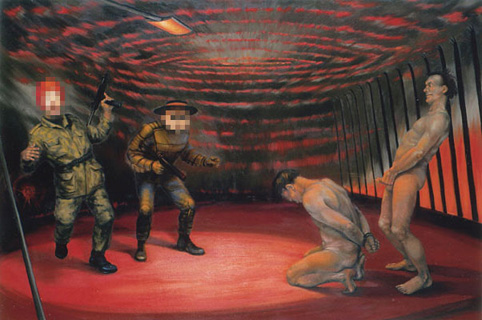
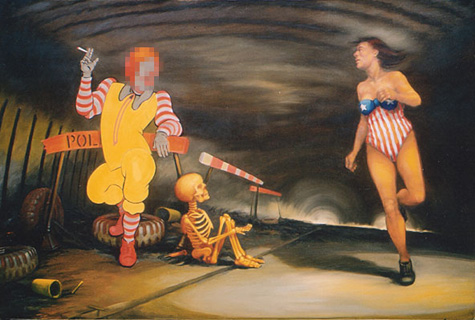
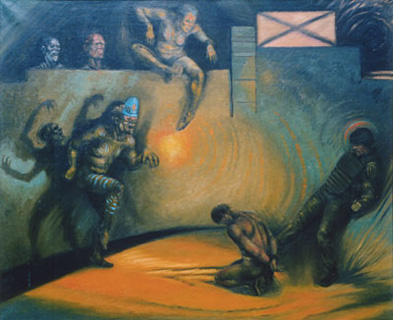
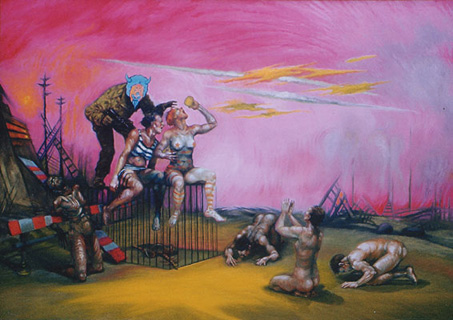
The 'Urban Epic' series relates to a period of time in London, (the early 90s), when there was much discussion and worry about violence in urban life. Following that rather exotic event called the 'Poll Tax Riot'(which I had witnessed), discussions in the media often featured social and political analysts, politicians, etc., who all premised their arguments with the assumption that urban life was unbearably violent. This of course did not address the issues raised as political ones, nor did it illuminate our understanding of urban living. However, it is striking how common and lazy an assumption it is that cities are cauldrons of ubiquitous and gratuitous violence.
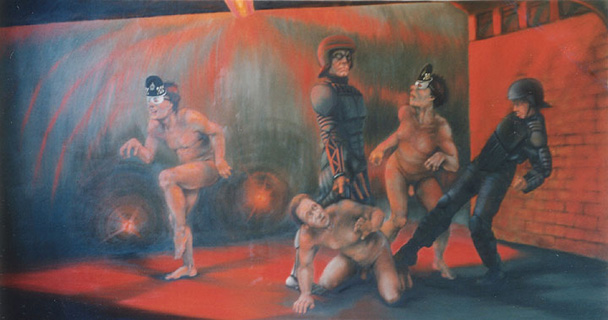
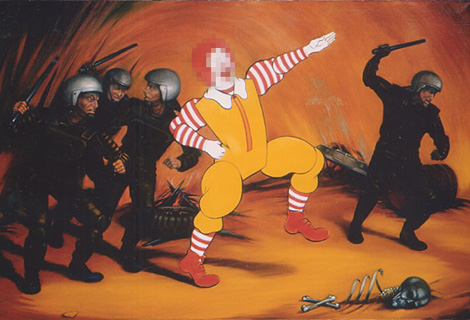
Intrigued by the gap between these assumptions and one's daily experience which so obviously contradicts that belief, I set out to 'picture' the city as described. I wanted to portray the world that we were allegedly meant to be living in, and the world that policy makers were operating from. The series of paintings were completed in 1996.
One consequence of this series is that I continue to be intrigued by the way in which we publicly engage with fictions and with how these shape our common beliefs about social and cultural norms. To those in academic circles working in political philosophy, the concept of a 'social imagination' is employed to help discuss how individuals understand, describe and act in a society. The emphasis is on the notion of shared narratives. What interests me is that this concept has implications for Art Theory.
For example, there is a long and deep history of painters who hold that they are realists, and that painting (i.e., depiction) is an objective activity. More specifically, the claim is that depiction is an activity that involves 'recording' (not copying) the experience, (or perhaps more accurately, the imagination?) of more than one individual. Realists have often been dismissed as over-reaching by opponents who insist that artists can only 'express' their own private thoughts and feelings and therefore, painting can only be an egocentric activity. Equally, it is assumed that the imagination too is idiosyncratic. However, if this is true, then how is it that when we, say, visit the National Gallery, we do not wander through halls of hermetically sealed autobiographies of individuals?! Instead, we see and learn something new about the way 'people' (not the individual artist) lived and thought.
I would hold that it is within the domain of realist/figurative painting that one can best map public conceptions and particular narratives that shape how the world is understood, while at the same time lay bare the gap between experience as pictured, and experience proper. The Urban Epic series is my first attempt to explore just that.
|
City of Razors |
|
Letter from America |
|
Siren |
|
Dance of the Demagogue |
|
Street Party |
|
Happy Clappy |